



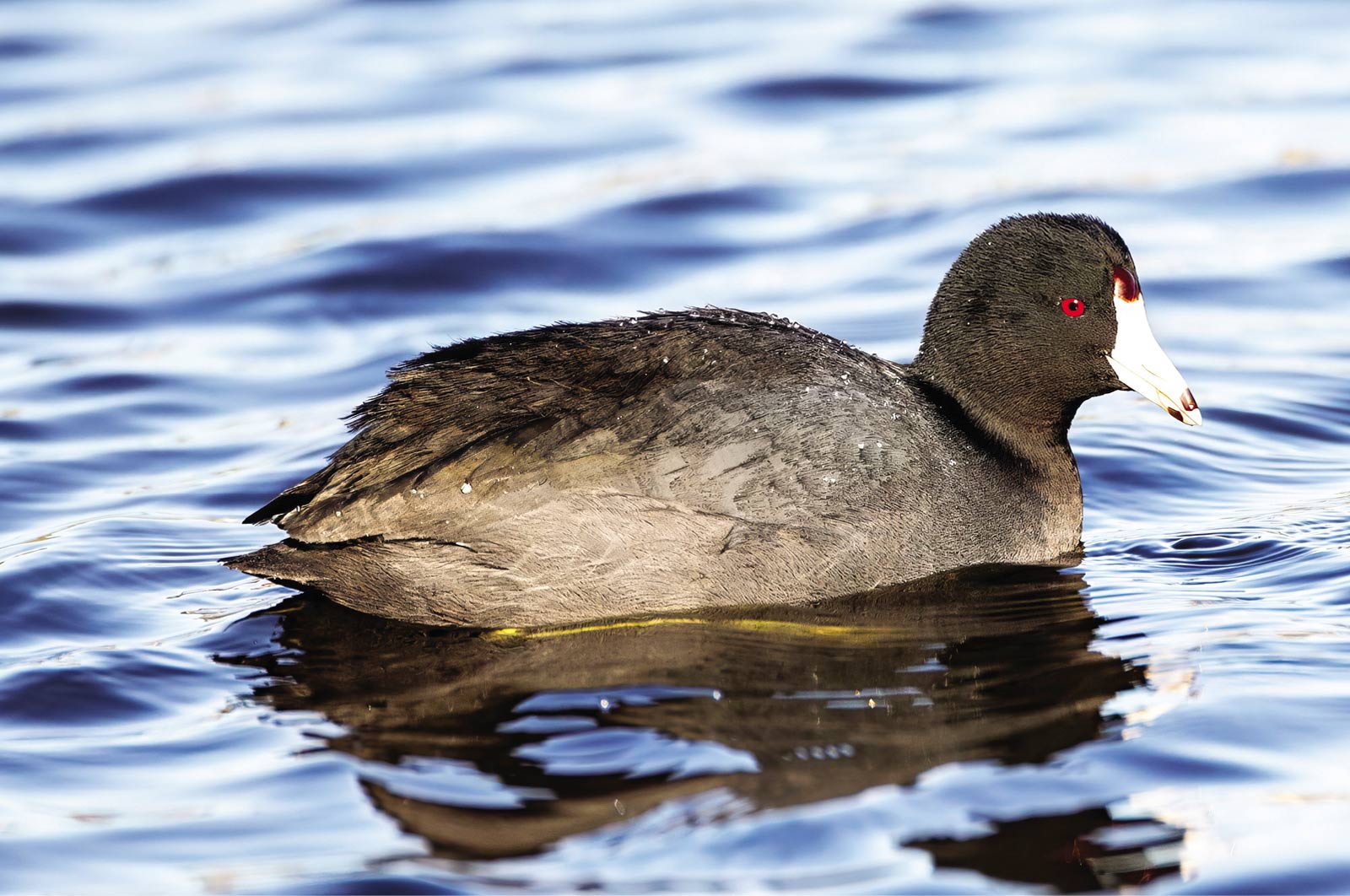
West Sound waterways host the most birds in winter. Thousands of geese, ducks, loons, and grebes spend the nonbreeding season here before returning to Arctic breeding grounds in spring.
But one species is unique in that it doesn’t fall into any of the aforementioned categories. Birders are sometimes asked what kind of duck is black with a white bill. Though it often gets dismissed as uninteresting, the American coot is as original as it gets.
The American coot spends the nonbreeding season in West Sound, where it’s present from fall to spring. Lone individuals and small groups may visit any lake or pond. The most reliable places for spotting scores or even hundreds of coots are the south end of Kitsap Lake in Bremerton and the ends of Long Lake near Port Orchard.
With an appearance that resembles a swimming chicken, the American coot is a wading bird, more specifically a member of the rail family. Although it often forages alongside ducks, the coot has features that are quite different from waterfowl.
In contrast to the short legs and waddling of ducks, the long, yellow-green legs of the coot make it a proficient runner. Unlike a duck’s flat bill that strains food from water, the coot has a thick, pointed bill for catching prey. A shield above the bill offers some protection during coot disputes. It continuously bobs its head while swimming, which helps it propel forward.
Another trademark coot feature is its feet, which are not webbed like swans, geese, ducks, alcids, and gulls.
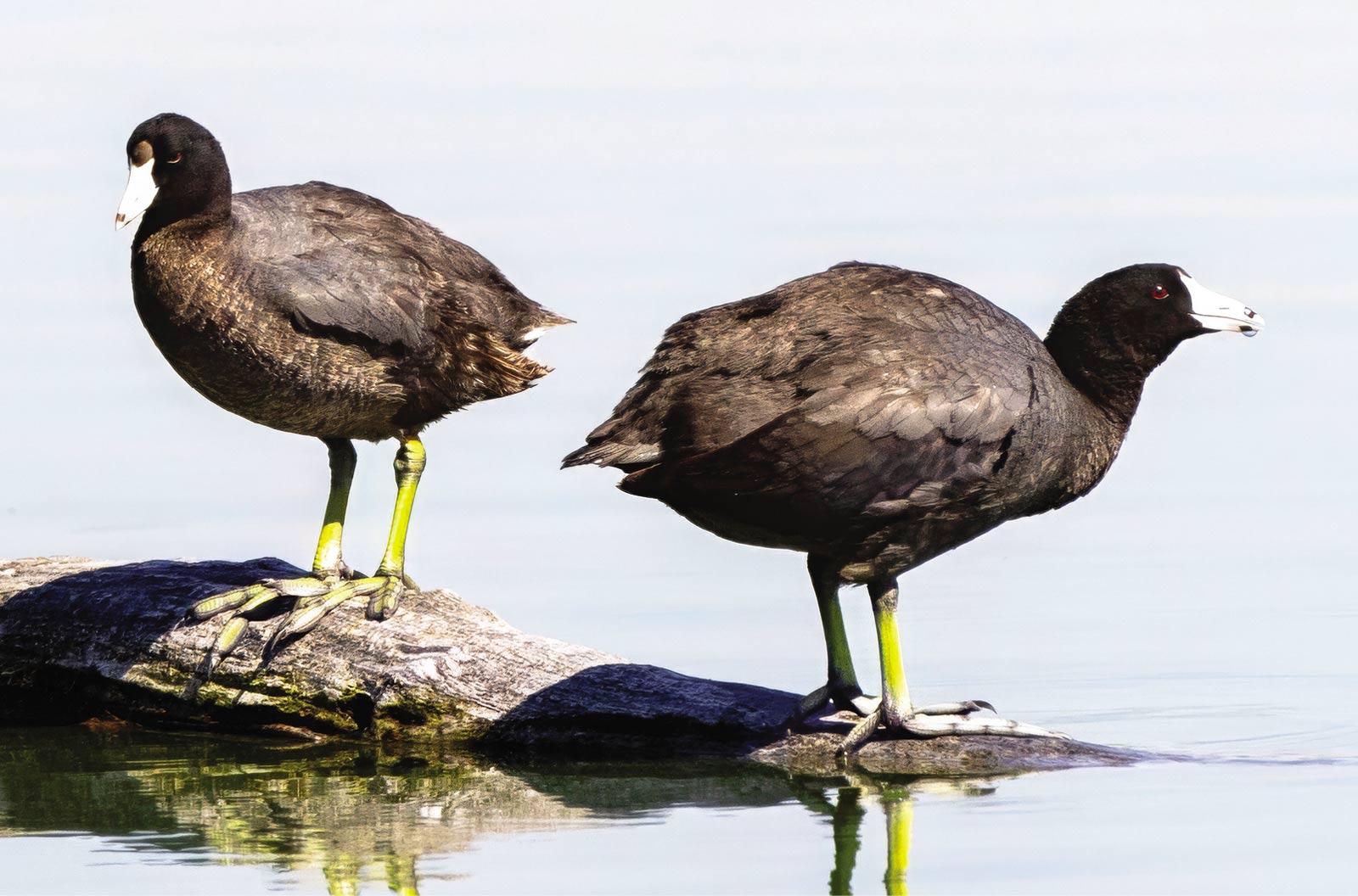
Rather, the coot has lobed feet that are similar to grebes. If necessary, the coot uses the claws on its long toes as weapons in territorial tussles.
The plump bodies and short wings of the American coot cause clumsiness and the need for a lengthy runway when taking flight. Only after a series of awkward flaps and gallops along the water’s surface can the coot lift off. Once airborne, sustained flight is strong and direct as it swiftly flies near the water’s surface. Migrating coots can travel at an altitude of 5,000 feet.
The American coot is a close relative of the Eurasian coot, which lives on every continent except the Americas and Antarctica. The American coot is a year-round resident across much of North America and the Caribbean Islands.
Ponds and lakes are an American coot’s preferred habitat. Bays and salt marshes are sometimes utilized. It primarily dines on plants, but also eats insects, tadpoles, crustaceans, snails, and other invertebrates. With a versatile approach to feeding, the coot forages on land, dabbles in shallow water, or dives for aquatic plants near the shoreline.
Peak numbers across Washington are typical from November through March, as rafts of hundreds or thousands of coots often associate with mixed waterfowl flocks in winter. Not surprisingly, a large gathering of gregarious coots is called a commotion, which is appropriate given their loud, frequent squawks.
The American coot is extremely aggressive toward virtually anything that gets in its way. Hence, the term “old coot” when referring to a grumpy grandpa. Whether it’s another coot, a duck, a shorebird, or even a snake, the territorial coot will chase away any intruder it perceives as a potential threat. Fights are sometimes violent and may result in the drowning of an opponent. Even a much larger great blue heron is not exempt from a barrage of angry coots.
Pairs nest on floating platforms of woven grass constructed in dense stands of cattails, reeds, and other tall wetland grasses. Both parents share the duty of incubating the brood of eight to 12 eggs. Hatchlings leave the nest within six hours of hatching. The endearing coot chicks are balls of black fluff on oversized feet. Bald, red heads are surrounded by a collar of orange feathers, which considerably heightens their cuteness factor.
Widespread American coot populations are stable. However, they can accumulate toxins from feeding in wetlands polluted by agricultural runoff and industrial waste. Thus, coots are indicator species for scientists monitoring the effects of environmental contamination.
Though it receives little attention, the American coot creates quite a commotion. Its unique features and pugnacious personality make it hard to ignore. It’s time to take another look at this fun, interesting bird.