



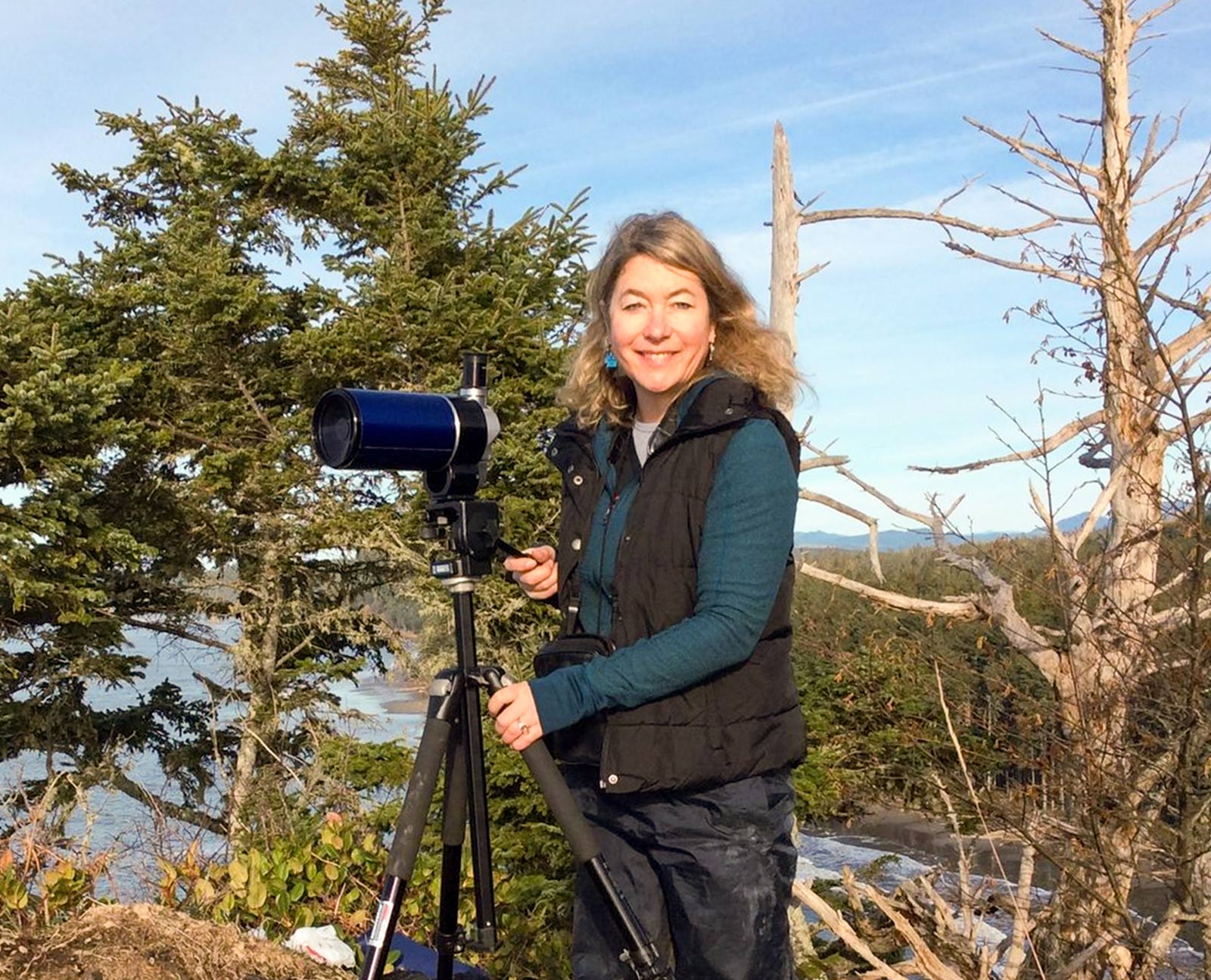
You might say that Shawn Larson, PhD, never met a sea otter she didn’t like. And you wouldn’t be wrong. But that’s just the beginning of a much longer conversation about someone who has spent her entire life researching a broad swath of living things, both on land and sea. Her curiosity and passion have driven Larson to become one of our region’s most respected and influential researchers and specialists in marine wildlife and ecology, and they have led to her ongoing efforts to support the Wild Society.
Located in Kingston, Wild Society is a small outdoor education nonprofit that, per its website, “works to establish relationships between human hearts and wildlife through adventure, scientific inquiry, storytelling and hands-on skills.”
Born in Portland and raised primarily in the Bay Area of California, Larson attended University of California, Berkeleyy to begin her journey into wildlife science, originally enrolled in the pre-vet program. But after meeting and marrying her husband and moving to Morro Bay, she focused her interests on wildlife ecology and biology, going on to receive a master’s degree at California Polytechnic State University, San Luis Obispo.
Jobs in her chosen field were limited, so in 1993, she made the bold move to relocate with her husband to Seattle, initially working as a veterinary tech at an animal hospital in Kingston. Although Larson credits that experience with giving her a broader understanding of life working in a veterinary clinical setting, she accepted an offer to work at the Seattle Aquarium as its animal health and research coordinator in 1995. This year, she celebrated her 30th anniversary with that esteemed facility and currently serves as its curator of research.
So, what’s the connection to sea otters, you ask? During her earlier years with the aquarium, Larson realized it would not be a stepping stone in her career but a long-term professional opportunity and commitment.
“While I was working full time, I pursued my PhD from the University of Washington studying sea otters,” Larson explains. A new passion was born.
Larson describes her current job as studying “everything from sea otters to sharks to giant Pacific octopus to rockfish to Hawaii reef fish and microplastics.” That panoply of interests led her to meet the founders of Wild Society in the early 2000s and accept an offer to join the volunteer board. That role quickly expanded into helping guide the nonprofit and serving as a facilitator for exploring wild areas along the coast. And sea otters.
“Shawn’s expert knowledge and passion for sea otter preservation is really amazing,” says Chris Ziobro, Wild Society’s board president. “We are immensely lucky to have her lead the sea otter weekend trip, as well as donating her time and energy to our board to help further Wild Society’s mission.”
Larson and her husband currently live on a small hobby farm in Hansville.
Why Wild Society
I believe in what Wild Society stands for: creating opportunities for people to fall in love with the natural world. I believe that people cannot be separated from conservation, and they will conserve and protect what they love. Thus, to facilitate conservation, you need to facilitate people’s interest in preserving wild areas. Plus, I just really like the people involved in the Wild Society — they are my people with similar values.
The importance of the work
My role as a board member is to not only help guide all the aspects of the nonprofit, such as the programs, the budget, the hiring of staff members, etc., but also to provide an opportunity for people to connect with wild areas along the Pacific Ocean. In that capacity, I lead the sea otter weekend, where I take campers to the outer coastal Washington to show them the wild Washington sea otters and talk about the importance of sea otters as keystone species, their role in promoting kelp forests, their role in biodiversity and the importance of complete ecosystems in the face of climate change.
The best part of the role
The best part is showing campers the importance of complete near-shore ecosystems, such as those on the outer coastal Washington with sea otters, and seeing them enjoy watching and finding out about these amazing animals. I also love interacting with the Wild Society community, not only the staff members but also the campers.
The biggest challenge
My biggest challenge has been figuring out how to help the overall operations and running a small nonprofit like the Wild Society, as I’m a biologist and don’t run a nonprofit. The financial reality can be tough at times. Wild Society has so many great programs we want to offer, complete with scholarships for people who can’t afford to go on the camps, that we try hard to make sure we have the finances to do all the great work we want to do.
The best compliment
The best compliment I’ve received is from people who go on the sea otter weekend and say they never knew there were wild sea otters off the Washington coast and how important they were to the ecosystem. They leave wanting to help protect the otters. That’s the goal. I also usually get one or two people who offer to volunteer to help me do this work.
Things I can’t live without
I can’t live without my darling husband. I can’t live without my pets — I have a mini Aussie, a cat and a horse. I can’t live without seeing my family often, my kids and my folks. Oh, and I do like an occasional glass of wine.
Ways to relax
Regular walks with my mini Aussie and my husband, and I ride my horse. Also, I find the sea otter fieldwork extremely relaxing.
Other hobbies and interests
I do like to scuba dive for fun, even though I get paid to do that for my job at the aquarium. My hobbies mostly involve interacting with my animals, my family and nature. I guess I have the right job and family setup. I am very lucky.